
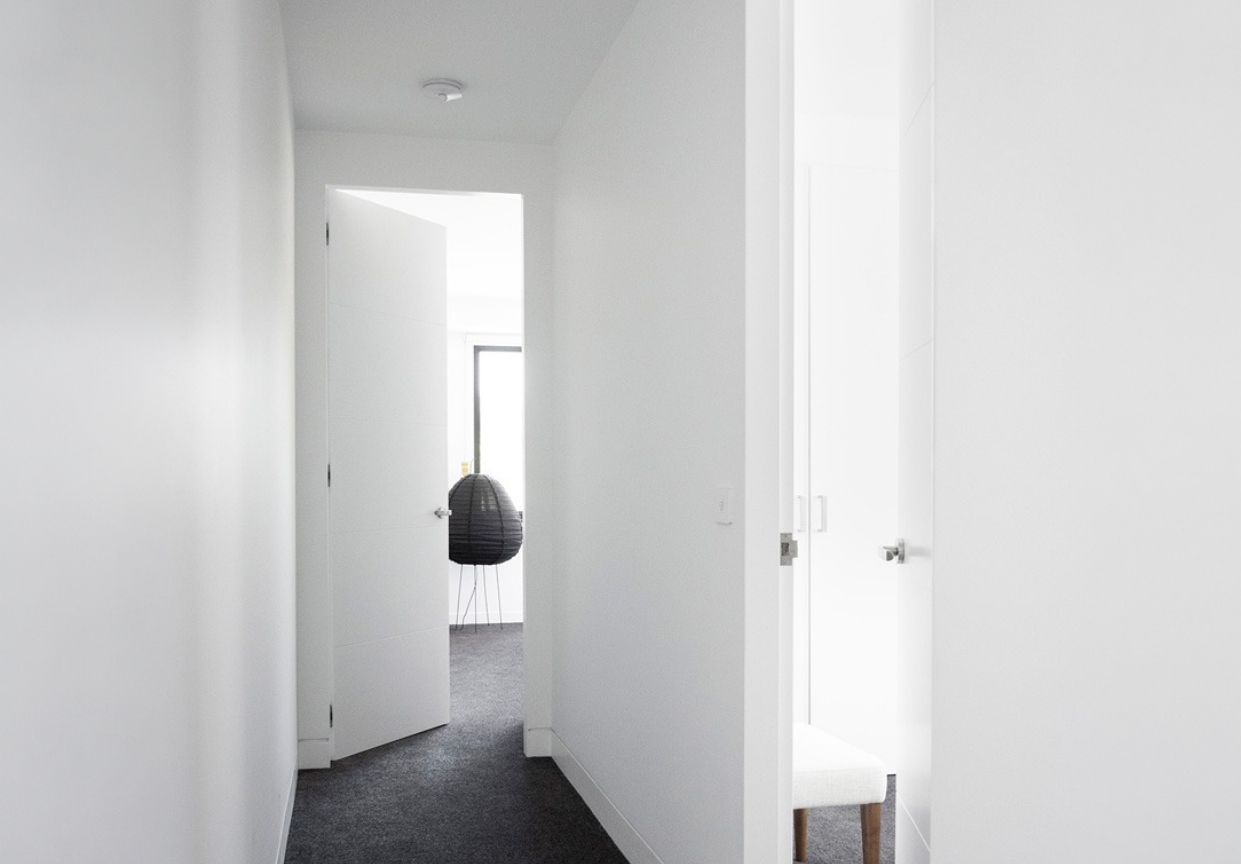
A perfect flush door finish starts before plastering, painting, or final fit-off. It depends on the right door frame system, a compatible solid core door, accurate wall preparation, and considered hardware.
For new builds and renovations, the cleanest result usually comes from specifying a complete flush door system. INVI Concept’s INVI Door Flush Primed Doors can be paired with INVI Jamb concealed door frames and INIV Hardware for a refined architectural finish.
What is a flush door finish?
This gives the doorway a minimal, square-set appearance. The door feels integrated into the architecture, rather than added onto it.
A flush door finish is often used in:
- New residential builds
- Apartment interiors
- Commercial fit outs
- Hotel and hospitality spaces
- Renovations with a contemporary design brief
- Galley style interiors
- Minimalist homes
The goal is to remove visual clutter and let the wall, opening, and door sit as one clear detail.
A flush door finish removes visible architraves and creates a cleaner architectural line.
Why is the door frame so important?
A traditional timber frame usually needs architraves to cover junctions. A concealed door frame is designed to sit within the wall build up.
The INVI Jamb concealed door frame system is designed to eliminate architraves and create seamless clean lines around the door frame. It’s made from premium galvanised steel and designed to accept a high-level finish for a smooth transition between wall and door face.
Flush finishes rely on precision. The frame must support the wall lining, the door leaf, and the final painted surface.
The right frame turns a flush finish from a styling choice into a proper construction detail.
What makes INVI Door Flush Primed Doors suitable?
INVI Concept offers INVI Door Flushed Primed Doors as part of a complete flush door system. The doors are solid core, machined to match the frames, and designed for a premium architectural finish.
Key product details include:
- 44mm or 54mm door thickness options
- FD30 or FD60 fire rating
- Hinge and lock preps machined to match frames
- Primed surface ready for finishing
- Available with INVI Jamb orders
The primed doors use hardwood lipping, a smooth GDC resin paper surface, and an Acid Catalyst Paint primer. This helps create a smooth, seamless look before final decoration.
A compatible solid core flush door improves alignment, detailing, and final surface quality.
How should flush doors be planned in a new build?
The design team should confirm:
- Door locations
- Wall thicknesses
- Door heights and widths
- Fire rating requirements
- Acoustic requirements
- Hinge type
- Handle or lock requirements
- Paint finish
- Full-height or standard-height options
Early specification helps avoid site compromises. It also allows the frame, door, and hardware to work as one coordinated system.
For projects using INVI Jamb, the jamb is designed to wrap the drywall during framing and blend into the wall. This supports the square-set interior finish expected in design-led projects.
New builds offer the most direct path because the flush door system can be planned from the framing stage.
How can flush doors work in renovations?
Before committing to a flush finish, check:
- Existing wall structure
- Stud condition
- Wall thickness
- Opening size
- Floor levels
- Plasterboard condition
- Fire or acoustic requirements
- Whether surrounding finishes will be replaced
A renovation may need extra preparation before installing a concealed frame. This may include reframing, straightening the opening, or replacing wall linings. The benefit of this extra preparation is visual control.
A flush door finish can modernise older interiors without relying on decorative trim.
Renovations can achieve a strong flush finish, but preparation is more important than speed.
What role does hardware play in a perfect flush finish?
For a refined finish, consider:
- Concealed hinges
- Slim door closers where required
- Minimal handles
- Integrated lock solutions
- Hardware finishes that suit the wall and door colour
INVI Hardware is designed to suit the INVI Jamb system. They remove the visible hinge barrel and help maintain uninterrupted clean lines around internal doors.
Hardware should disappear into the design, rather than compete with the flush door finish.
How do you finish and paint a flush door system?
For a clean result:
- Sand surfaces evenly
- Remove dust before priming or painting
- Use compatible paint systems
- Keep edges sharp and clean
- Avoid heavy paint build-up around margins
- Check the door swing after each coat
- Maintain consistent sheen across wall and door
Many flush door finishes are painted the same colour as the wall. This creates a hidden-door effect. Others may use a subtle contrast to define the opening.
The best approach depends on the design intent. The key is consistency across door, frame, walls, and hardware.
Paint should refine the flush finish, not compensate for poor quality craftmanship.
What are the most common flush door finish mistakes?
Common Mistakes:
- Choosing a standard frame instead of a concealed frame
- Specifying the door too late
- Ignoring wall thickness
- Using incompatible hinges
- Forgetting fire or acoustic seals
- Allowing poor plasterboard alignment
- Painting before checking door margins
- Treating renovations like new builds
- Mixing untested components on fire-rated openings
A flush door finish works best as a system; frame, door, seals, hardware, and wall finish should be selected together.
Most mistakes come from treating flush doors as a late-stage aesthetic choice.
What is the best way to specify a flush door finish?
For a refined result, specify:
- INVI Jamb for architrave-free openings
- INVI Dor for compatible solid core door leaves
- INVI Hardware for clean uninterrupted lines
- Fire and acoustic seals (where required)
- Accurate wall preparation before plastering
- Final paint finishes that suit your design intent
For projects with multiple openings, it’s worth preparing a door schedule. This keeps door types, sizes, ratings, and hardware consistent across the entire build.
INVI Concept also provides a quote request service where project details, INVI Jamb frames, and solid core doors can be selected for specification.
A perfect flush door finish starts with the frame, door leaf, and construction sequence.
For UK new builds and renovations, INVI Concept provides a coordinated way to achieve a perfect flush door finish. The combination of INVI Jamb, INVI Dor, and INVI Hardware gives architects, builders, and designers a cleaner path to a minimal, confident interior finish.