
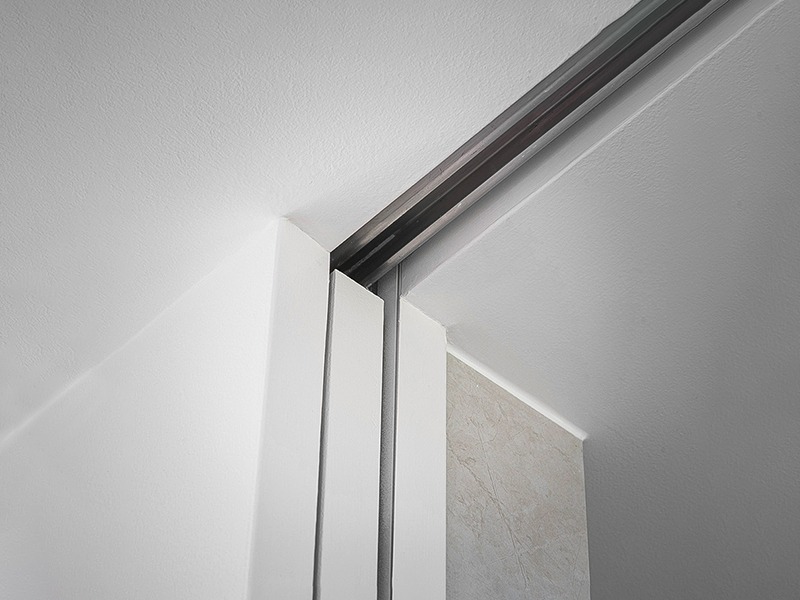
What Is a Traditional Sliding Door?
They do, however, come with trade-offs:
- Reduced wall space, as the open door occupies a section of wall face
- A visible track and door leaf, even when open
- Limited scope for a flush, architrave-free finish
Section summary: Traditional sliding doors are easy to retrofit but remain visible against the wall and cannot achieve a fully flush, architrave-free result.
What Is a Flush Pocket Door?
Where the cavity and sliding gear are already in place, a system such as INVI CavKit trims and caps the plasterboard edges around the opening, creating a square-set finish with no visible architrave on any side.
Section summary: A flush pocket door slides into the wall cavity and disappears entirely when open, with no visible track or architrave.
Space and Layout: How Do They Compare?
This makes flush pocket doors particularly effective in:
- Bathrooms and en suites where swing space is limited
- Narrow hallways and galley kitchens
- Open-plan layouts where sightlines and circulation matter
Section summary: Flush pocket doors recover more usable space than traditional sliding doors by removing both the swing arc and the visible wall-face footprint.
Finish and Detailing: What Sets Them Apart?
Hardware plays a role here too. Visible recessed pulls or protruding handles work against a clean aesthetic, so hardware such as NoHa invisible handles, recessed into the door face with no projecting lever, should be specified alongside the pocket door system rather than added later during second fix.
Section summary: Flush pocket doors with CavKit and flush hardware create a continuous wall surface, while traditional sliding doors retain visible track and door detailing at all times.
Which Should You Specify?
Section summary: Choose a traditional sliding door where a cavity is not possible or a visible door is part of the design; choose a flush pocket door with CavKit for a clean, architrave-free result.
Specify INVI CavKit
Request a quote, confirm sizing, and review compatible hardware at inviconcept.com. The team can advise on wall build-up requirements for your specific renovation.